Introduction & Background:
The use of actuarial risk and needs screenings and assessments is becoming standard practice in the criminal justice setting. As part of broader criminal justice reform efforts, in 2015, Utah implemented a statewide risk and needs process that uses the LSI-R:SV to screen for an individual’s risk-to-reoffend when booked in any of its county jails. The LSI-R:SV is part of a family of risk and needs screenings and assessments. The screening version was developed to quickly identify and triage individuals who may require a more extensive risk assessment (i.e., the LSI-R). This shorter risk-and-needs screening version is an 8-item actuarial tool that classifies individuals into three distinct categories: low, moderate, and high risk of reoffending. It includes seven important risk areas, namely the individual’s:
- criminal history
- criminal attitudes
- criminal associates
- personal/emotional
- employment stability
- family relations, and
- substance abuse (that interferes with employment)
In the jail setting, the information obtained by the risk classification can be used for:
- determining the need for a full risk and needs assessment,
- guiding jail housing decisions (prevents mixing low and high risk populations), and
- assigning supervision levels if placed under community supervision.1
While research on the efficacy of the LSI-R:SV has highlighted its strengths as effectively distinguishing low risk individuals from moderate and high risk, predict future recidivism, and reserve scarce correctional resources by reducing the time spent administrating the tool (Lowenkamp, Lovins, & Latessa, 2009), there is a continuing need to examine the instrument’s ability to distinguish new criminal behaviors by each risk classification. To address this need, this research explores re-arrest patterns among individuals screened for their criminogenic risk and needs using the LSI-R:SV who were released from Salt Lake County Jail between 2017 and 2019. We further recommend risk classifications by analyzing survival curves for each individual risk score.
Findings:
Many returns occur early, with higher-risk individuals returning more frequently. The most common primary offense was property-related (~60%), followed by alcohol & drug offenses (23%) and person offenses (10%). A significant portion (86%) was assessed as intensive or high risk, with 56% having high substance use treatment needs.
-
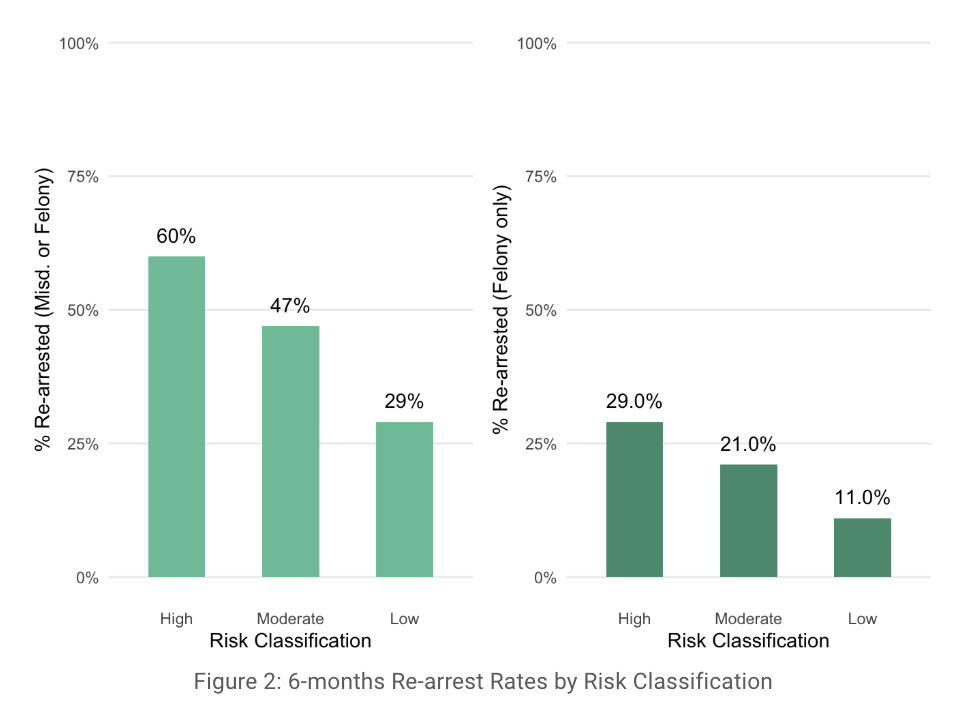
Individuals classified as low risk experienced half the rate of re-arrests than those classified as high risk when the definition of a new arrest includes either a Misdemeanor or Felony offense. Those classified as low risk experienced an average re-arrest rate of around 30% compared to 60% for those classified as high risk.
-
The average re-arrest rate after jail release significantly declined when the definition of a new arrest is restricted to a new Felony offense and further increases differences in re-arrest rates between those classified as low and high risk. Low risk individuals experienced a new arrest rate of 11% in comparison to 29% for those screened as high risk, a difference of nearly 60%.
-
The LSI-R:SV effectively distinguished low risk females from those classified as moderate and high risk. Consistent with prior research, we find further support that the strength of the LSI-R:SV is to distinguish low risk individuals from those classified as moderate and high risk, with less accuracy distinguishing new arrests between moderate and high risk individuals for females for when the outcome is restricted to a new Felony offense only.
-
While the share of females classified as high risk was higher than for males, high risk females experienced fewer instances of new arrests than high risk males. Females classified as high risk experienced an overall re-arrest rate of 55% vs 63% for high risk males.
-
Current risk classifications appear appropriate for Utah’s jail population though considerations around adding a very low risk classification could be beneficial for certain criminal justice decision points. Survival analysis around each risk score revealed that current categories correlate well with actual instances of new arrests but that the low risk classification may be separated into two distinct categories.
Read the full report:
Risk & Needs Screening