Overview:
Introduced in December of 2019, the Davis County jail diversion program aims to provide an alternative to traditional arrest or citation for adults who have engaged in certain lower-level drug crimes and misdemeanor offenses. Instead of traditional paths, the program allows referral to appropriate treatment services to avoid the stigmatizing and often costly criminal justice track. Critics of jail diversion programs argue that public safety will be compromised as individuals offered treatment in the community now have the opportunity to commit similar and even more severe crimes.
Research Question:
As such, we pose the question of whether there is evidence that the Davis County jail diversion program has had an adverse effect on public safety, as defined as increases in the volume and characteristics of jail bookings through time.
Study Method:
A simple difference-in-differences approach is utilized to account for general time trends to estimate a treatment effect for booking volumes made by law enforcement agencies that could refer to the program (the treatment group) to law enforcement agencies where referral opportunities were not yet made available (the control group).
-
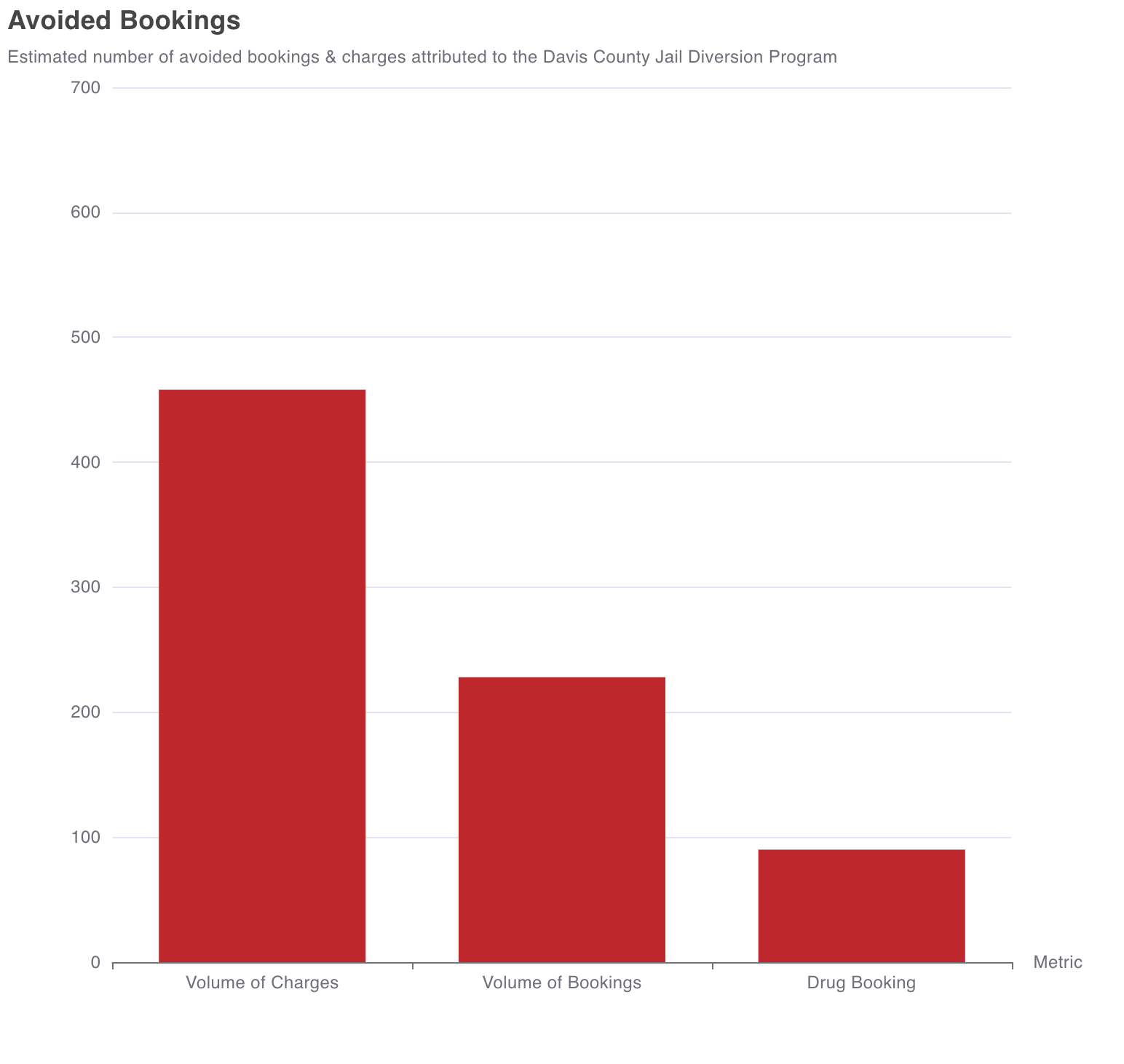
Defining Public Saftey: We define public safety in 3 distinct ways: the volume of total jail bookings, drug related jail bookings, and the volume of charges associated with these bookings before and after program roll-out by law enforcement agencies referral type.
Preliminary Takeaways:
We find no evidence that the Davis County jail diversion program has a negative impact on public safety when public safety is defined as either increases in the volume of total jail bookings, drug-related jail bookings, or the number of charges associated with these bookings after program roll-out. Preliminary cost analysis suggests that the program is effective in regard to reduced bookings within the county.
Recommendations:
Extend the study period and analyze outcomes of those who participated in the program. These outcomes may be associated with re-arrest rates and treatment engagement. The established and strong link between substance use disorders and low-level property offenses, including theft, warrants a closer look at the current inclusion criteria to see if additional offense types could be eligible for the program, which has the potential to capture a larger share of those in need of substance use services.
Read the full research brief below:
Evaluating the Early Public Safety Impact on Davis County Jail Diversion Program