Introduction
Over the last five years, Utah has analyzed its criminal justice system and focused considerable attention on the drivers of its prison population. Now, the areas of probation and parole are taking a more prominent role in reform conversations as stakeholders recognize the impact that supervision populations have on their prison populations as well as in the community. This trend is also occurring nationwide: 45 percent of all prison admissions are for supervision violations, and nearly a quarter are for technical violations (noncompliance with one or more rules of supervision). In fact, as a result, on any given day, nearly 1 in 4 people in prison in the U.S.—about 280,000 people—are there because of a supervision violation. There are, however, numerous steps Utah can take to improve its community supervision system while strengthening community safety.
Key Data Findings
The task force’s data analysis revealed considerable growth in both parole and probation admissions – demonstrating a growing recognition that community-based corrections are a critical and effective alternative to incarceration. However, an increase in supervision revocations is driving prison admissions and resulting in a larger prison population. The data revealed four key findings about the state of the community supervision system in Utah:
- Utah’s community supervision population has undergone steady growth since 2012
- Supervision revocations for both probation and parole have also increased
- The growth in Utah’s prison population is driven by these revocations
- Technical revocations of supervision are pervasive, resulting in terms of imprisonment longer than 60 days.
Utah’s Community Supervision Population Has Undergone Steady Growth
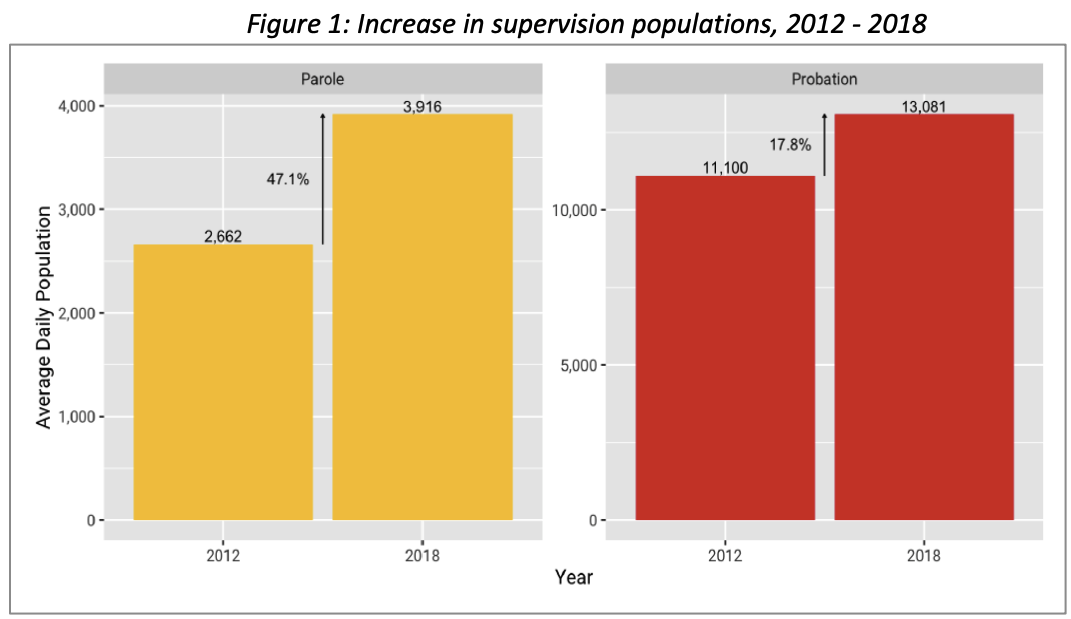
Since 2012, both the probation and parole populations have increased by 17.8 percent and 47.1 percent, respectively, due largely to a growth in admissions (see Figure 1). For probation, the increased population is commensurate with a decline in new court prison commitments, which suggests that the court is utilizing probation instead of incarceration at a higher rate. Over that same time period, the Board of Pardons and Parole (BOPP) has also released more individuals from prison, leading to an expansion of the overall parole population.
While it can be challenging to supervise more people generally, the growth in the supervision populations was compounded by an increase in higher risk individuals, necessitating caseloads that require more time and attention. Between 2013 to 2018, the proportion of high-risk individuals on probation rose from 41 percent to 44 percent and from 10 percent to 18 percent for intensive-risk. Although there was a drop in high-risk individuals on parole (from 61 percent to 49 percent), the proportion of individuals assessed as intensive-risk rose from 15 to 25 percent over those same five years. Supervision for higher-risk individuals includes more frequent reporting and in-person meeting requirements, thereby increasing the overall workload for AP&P agents. According to the agent survey results, there is a split as to how much their caseloads allow them to promote successful completion of supervision and ensure public safety. Approximately half of respondents reported that their caseloads allowed them to complete these tasks either “somewhat,” “considerably,” or “a great deal,” while the remaining half said that they were only able to do so “a little” or “not at all.”
Recommendations
-
Recommendation #1: Revise the application of the Response and Incentives Matrix and provide for more community alternatives
-
Recommendation #2: Modify the application of legal financial obligations
-
Recommendation #3: Establish performance measures and a means of data sharing among relevant agencies
-
Recommendation #4: Establish key stakeholder engagement through individuals impacted by the criminal justice system
Read the full report:
Task Force on Community Supervision Report