
January 1, 2026
Habitual Offenders (SB213) Preliminary Evaluation: Community Supervision 2025
Overview: This report evaluates the characteristics and outcomes of individuals under AP&P supervision that are classified as habitual offenders, as defined by SB213. Senate Bill 213 (SB213) classifies individuals with six or more felony convictions within the past five years as habitual offenders. This report examines the characteristics and outcomes of habitual offenders under AP&P supervision using data from the
January 1, 2022
Report: Justice Reform and Crime Rates 2022
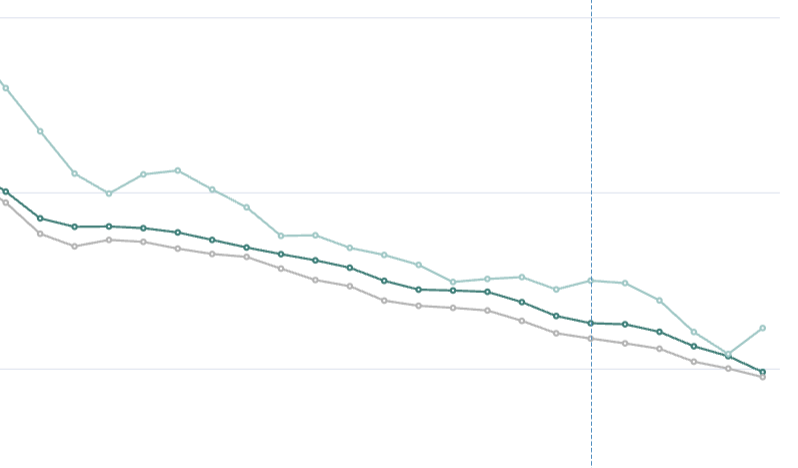
Overview: Since the early 2000’s, 40 US states have passed criminal justice reform legislation, often formally called the Justice Reinvestment Initiative (JRI). These reforms, while varying by state, aim to improve system performance while controlling costs. Research Question: Critics of justice reform initiatives often argue that the “softer” policies in these reforms may negatively impact public safety, with recent concerns

January 1, 2021
Report: Risk Factors for Females on Parole 2020
Summary: Improving outcomes for individuals under correctional supervision is a core focus for criminal justice researchers and professionals. Here we analyze a cohort of over 500 females on parole in Utah between 2013 and 2017, using time-to-event analysis. We find that risk factors for females on parole are different when the outcome variable denotes a technical violation versus a new

January 16, 2020
Research Brief: HB348 Policy Shifts—Trends in Traffic & Drug Filings 2019
Overview HB348 made substantial changes to practices and procedures in Utah’s criminal justice system. Targeted policy shifts included penalty reductions to certain low-level traffic and drug-related offenses to reduce the burden placed on local jails and the state’s prison population. Traffic Filings Policies in the reform bill reclassified certain low-level traffic offenses from a Misdemeanor C to an Infraction. The figure

January 1, 2020
Report: The Link Between Race-Ethnicity and a Pre-Sentence Prison Recommendation 2019
Summary: In Utah, a recommendation of probation, jail, or prison should be based on an offender’s criminal history score and the severity and type of their most recent offense. Additionally, the offenders’ mitigating/aggravating factors are taken into consideration. The criminal history score is based on the offender’s past involvement with the justice system. The score then places offenders into a

January 1, 2020
Report: Predicting New Criminal Convictions while on Parole—The Role of Offense Type 2019
Summary: Understanding factors behind sustained criminal justice involvement is a primary focus of criminal justice research and professionals. Here we examine the relationship between offense type and new criminal convictions for offenders on parole in Utah. By analyzing 3,173 parolees released from Utah’s state prison in 2013 and 2016, we find that offenders convicted of a sex-offense have a reduced

January 1, 2019
Report: Examining Parole Revocation Patterns 2018
Summary: In the state of Utah, a revocation to prison from parole can occur in two instances: (1) if the offender failed to comply with their supervision conditions, and (2) if the offender was convicted of a new crime while on parole. It should be emphasized that changes in revocation rates over time may reflect changes in offender behavior rather

January 1, 2017
Report: CCJJ Death Penalty Working Group 2016
Summary: This paper originates from a Utah Commission on Criminal and Juvenile Justice (CCJJ) working group’s discussions regarding the death penalty. In June 2016, CCJJ directed the creation of a working group to study the death penalty in Utah. CCJJ tasked the working group with examining: (1) current statutory aggravators; (2) costs; (3) public attitude; (4) victims’ rights; and (5) other

January 1, 2016
Report: Piloting Utah’s Response and Incentive Matrix—Results from Staff and Stakeholder Surveys 2015
Summary: In 2013, The Utah Sentencing Commission appointed a committee to research and develop an incentive matrix for Utah probationers and parolees. Members participating in this committee included representatives of the Utah Sentencing Commission, Administrative Office of the Courts (AOC), Commission on Criminal and Juvenile Justice (CCJJ), Utah Department of Corrections (UDC), specifically the Adult Probation and Parole (APP) division,