Summary:
In the state of Utah, a revocation to prison from parole can occur in two instances: (1) if the offender failed to comply with their supervision conditions, and (2) if the offender was convicted of a new crime while on parole. It should be emphasized that changes in revocation rates over time may reflect changes in offender behavior rather than the nature and enforcement of criminal justice policies and practices. Additionally, it may not reflect general health trends or other dynamic social phenomena. With this in mind, this study examines revocation patterns through the lens of Utah’s current criminal justice policies, using a 1-year follow-up period.1 Its main findings may be summarized as follows:
- While ceilings on parole revocations are reducing parole violators’ prison length of stay, previous parole violators are continuing to cycle through the system. Such findings hint at an increased need of effective interventions for this on average, high risk population.
- Increases in new convictions while on parole are being driven by non-violent offenses. Such non-violent offenses are primarily comprised of drug possession only crimes.
The above findings warrant a closer look at the causes of revocations and their interplay with revocation length of stay, implementation fidelity, organizational capacity, and current enforcement practices. Overall, the nuances of these findings highlight the ongoing need to collect and monitor data, as well as the importance of conducting further analyses to elucidate current criminal justice trends.
Data & Method
A total of 4,541 unique parole starts were obtained from the Utah Department of Corrections’ (UDOC) database O-Track.5 In order to delineate the pre- and post-reform time frames, these data were divided into four distinct cohorts. The first cohort had a parole start date between October 1, 2013, and March 31, 2014; the second cohort started parole between October 1, 2014, and March 31, 2015; the third cohort had a parole start date between October 1, 2015, and March 31, 2016; the fourth cohort started parole between October 1, 2016, and March 31, 2017. Each cohort was followed for one year from their respective parole start date. The outcome variables of interest were dichotomized into two variables: the first denotes whether the parole was returned on a technical violation only, and the second denotes a revocation based on a new conviction.
To account for changes in the parole population and as informed by prior literature, demographics in the form of age and gender serve as important covariates. Additionally, criminal justice variables comprising of offense type, offense severity, and the parolee’s risk to re-offend (available through the Level of Service: Risk-Need-Responsivity [LS:RNR] instrument) are included.
Results
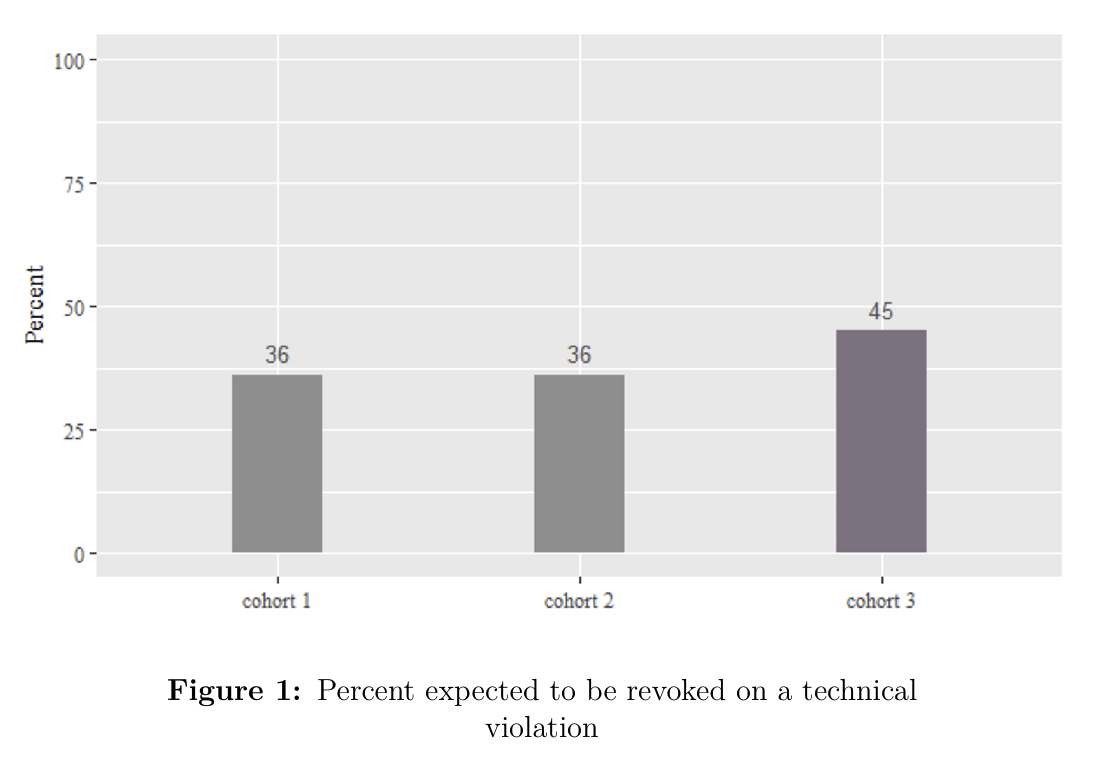
This section explores prison revocations due to one or more technical violations. Figure 1 illustrates the expected revocation rate by cohort. As shown in the figure, the two pre-reform cohorts have a similar expected return rate of 36 percent, while cohort three shows a higher expected return rate of 45 percent. The variable denoting whether it was the offender’s first parole start was among the most important variables, as determined by the BMA process, and showed a relatively large negative average coefficient (see Appendix A). Because this part of the parole population is decreasing over time, this finding warrants a closer look at this subset.
Figure 2 illustrates the expected revocation rates by cohort, restricting the sample to those on their first parole start. As seen in the figure, all three cohorts have a similar expected rate of just below 30 percent. Hence, the BMA process does not highlight a difference in the likelihood of revocation for a technical violation across groups when restricting the sample to this subset of the population.
Read the full report:
Examining Parole Revocation Patterns